Navigational Pages

Showing posts with label nasa. Show all posts

Wednesday, August 31, 2016

How To Watch Annular Solar Eclipse September 1, 2016 - The African Ring of Fire Aka 2016 Annular Solar Eclipse Event

A rare event is going to happen on September 01, 2016 and bear witness to the African Annular Solar Eclipse 2016, were most part of the continent of Africa will be covered and visible on Thursday were a Ring of Fire will rise and set over the African continent, as an Annular Solar Eclipse passes over a large portion of the globe. Aka Annular Solar Eclipse, the ring of fire will begin at one end of the continent, very early in the morning, and end on the other side, off the coast of the famous island of Madagascar. While the full eclipse will only be visible along a very thin line through central Africa, partial phases will be visible on nearly the entire continent. If you can't make it in going to Africa, that's fine because a live feed will show you on how to watch the annular solar eclipse as well as where to watch it online via live streaming online. Make no mistake, The Partial Eclipse visibilty covers Africa, Indian Ocean while Annular Eclipse perse covers Atlantic, central Africa and Madagascar. So the rest of Africa will just enjoy a partial solar eclipse on September 1st, from Aswan, Egypt (where you'd see a tiny 3% of the Sun's disk covered) to 69% coverage in Nairobi, Kenya, to 40% in Pretoria, South Africa. Be warned! since you will be looking an obscured sun, it is always to be cautious and always put safety goggles or to avoid permanent eye damage and blindness, you should probably sport some protective eye-wear or wear an eclipse glasses just to make sure.


In other words an Annular Eclipse is similar to a Total Solar Eclipse wherein the Moon moves directly between the Earth and the Sun. But, unlike during a Total Solar Eclipse, the Moon does not completely obscure the Sun. During an Annular Eclipse, the Moon is farther away from the Earth, making it appear smaller. Therefore, the Moon only covers most of the solar disk, hence, leaving a “ring of fire” around the outer edge. During totality it is very exciting to watch the annular solar eclipse because the ring of fire it resembles is similar to that of the lord of the rings that is bursting with flame. Again it will be visible from Madagascar and locations in Central Africa. The Moon's shadow will also cross parts of the Atlantic and Indian Oceans. For most viewers in Africa, the eclipse will be a partial solar eclipse but in Madagascar it should be total. The eclipse will begin at 06:13 UTC on September 1, 2016. The maximum point will take place at 09:01 UTC, and the annularity will last for 3 minutes and 6 seconds which is pretty cool right? and simply because whenever you look or gazed on it, it's like there a key hole or portal in the the sky that takes you somewhere else across the universe:-) It is definitely not another so called apocalyptic event to watch for nor something about planet Proxima b and alien signals detected whatsoever. So, whether you are just planning to go on a safari in the great plains of Africa or simply enjoying Madagascar, always remember that an Annular Solar Eclipse is going to happen and Africa is in the spotlight after all this is Africa! :-)

Wednesday, August 10, 2016

Leonids Meteor Shower 2016 - Watch Leonid Meteor Shower Outburst Live On November 17 Peak!

Mark your calendar and brace yourself for a very exciting astronomical event because starting on Thursday night of November 17th, the Leonids Meteor Shower 2016 will have it's peak as the Earth will be passing through a stream of cloud of debris from Comet Tempel-Tuttle, which is the progenitor comet of Leonids, and are expected to produce up to a stunning 10-15 meteors an hour on the night of Thursday until Friday during it's outburst, which many considered to be somehow a meteor storm already. The Leonids are so named because the meteors appear to come from the constellation Leo, but it's comet Tempel-Tuttle that's responsible for the meteoroids. As the comet makes it 133-year journey around the sun, it leaves a trail of dust and debris. Earth crosses this stream each year around the middle of August. The Leonids has been one of the most documented and viewed meteor showers, with recorded observations for 2,000 years, according to NASA. Unlike last year, when expectations are somewhat highly anticipated and turned into a bit of frustration, this time we're hoping that it's going to be the other way around. And 2016 is quite special for Perseid Meteor Shower because according to Astronomer's forecasting the Perseids, it will be firing twice as fast on the night of August 11-12 but with a disclaimer as Bill Cooke, NASA’s head of meteoroid environments, said in a press statement that "Under perfect conditions, rates could soar to 200 meteors per hour," So if the night sky is clear enough you'll be able to see some bright meteors streaking through the sky also using only the unaided naked eye and since the moon will be setting in the early hours of Friday it's a pretty good chance of seeing the meteor shower's peak as the Perseid meteor shower occurs just every month of August when the Earth passes through a stream of dusty debris from Comet Swift-Tuttle, a comet that orbits the sun once every 133 years. The Perseids have been observed by humans for at least 2,000 years, according to NASA officials.


The meteors are made up of ice and dust shed by Swift-Tuttle, most of which was cast off by the comet hundreds of years ago in which the best time to observe the Perseids will be in the pre-dawn hours of Thursday, Aug. 13. "The Perseids streak across the sky from many directions, with theoretical rates as high as 100 per hour. However 2016 Perseid will be an exemption.


The last time the Perseids peak coincided with a new moon was in 2007, making this one of the best potential viewings in years that is, according to NASA but let's see the results and if you live in a big city with a lot of light pollution or even worst it's cloudy because weather is no good, there are still ways to watch the meteor outburst by Perseid because NASA says there will still be meteor activity on Friday and Saturday so you have all the chance and you can watch it live via NASA's streaming videos online which will be live overnight on Thursday and Friday, starting at 10 p.m. ET. So there's really no excuse for you not to see this much anticipated event, who knows your wish may now come true because the numbers of meteors you can see are really high enough on Perseid's peak so the more meteors you see the more chances of wishing. Good luck! :-)

Monday, January 26, 2015

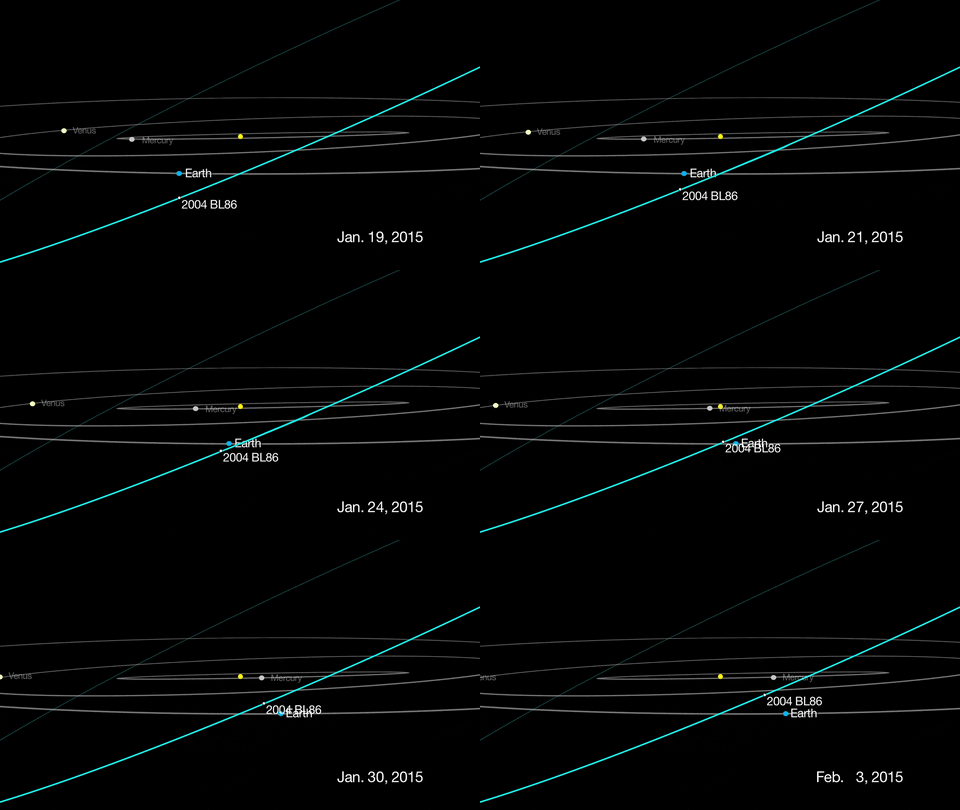
ASTEROID 2004 BL86 - A Potentially Hazardous Asteroid And Massive Zips Past Earth Today


On Monday January 26, 2015 a space rock a size of a mountain will zip past the Earth at 745,000 miles or 1.2 million kilometers which is about 3 lunar distance or distance between Earth and the moon. A giant asteroid which is about the size of a three football field which is about 1,800 feet or 550 meters wide named ASTEROID 2004 BL86 will have it's interplanetary journey particularly near the Earth-Moon system and describe to be an asteroid bigger than the world's most massive cruise ships in which if it were sitting on the Earth, it would be as tall as Toronto's CN Tower according to sources. But no worries as this huge asteroid categorize to be PHA or potentially hazardous asteroid or even Near Earth Asteroid will not fall on Earth otherwise the world as we know it will come to an end. Near Earth Asteroid 2004 BL86 is an eye-opening reminder of the potential risks of asteroid impacts and the importance of acquiring and tracking asteroid orbits because it is estimated that while 90 percent of the kilometer plus sized asteroids have been discovered, only 30% of the 140 meter-sized NEA's have been found with less than 1 percent of the 30-meter sized NEA's having been detected which means, your guess is good as mine.

None animated GIF

The distance of Asteroid 2004 BL86 is in a safe distance though closer than any other asteroid this big will come until 2027, it's the year when we can expect a visit from another asteroid called 1999 AN 10. The huge asteroid will probably be easiest to find around 11 p.m. ET when it will be to the right of the planet Jupiter and between the constellations Leo and Gemini and it will look like a slow moving star or satellite according to Randy Attwood, executive director of the Royal Astronomical Society of Canada plus NASA will also be watching the asteroid to capture images and data using its Deep Space Network antenna at Goldstone, California and the Arecibo Observatory in Puerto Rico will also be following the close approach. So worry no more but relax and enjoy the night sky because this is something that doesn't happen every single day or maybe not:-)

Thursday, December 4, 2014

Orion Spacecraft Launch - The next generation of space travel into deep space


The Human Space Exploration is about to change forever as the Orion Launch is about to happen were the limits in space exploration sets no boundaries to the far reaches of the universe when NASA's Orion Launch on December o4, 2014 in Cape Canaveral, FL USA rolled out to do a series of testings once in outer space to ready the humans in a much longer space flight just like in the movie Interstellar were the Endurance travel across the universe via wormhole located near Saturn, although in a much real situation the Orion is equipped with the latest technologies including the chutes, the onboard computer, and many others to the the recordings of every detail so that when it's time for humans to travel in space like going to Mars and beyond, every thing is all set. But things happen for the reason as the much anticipated Orion Launch day for NASA's Orion spacecraft will be delayed and will resume it's launching on Friday instead because of some problems encountered such as weather problems, including wind gusts, a stray boat in the launch zone and technical issues that causes the delay. But on Friday it will be mankind's another historic moment when the Orion Launch commence, hopefully, and will be carried by a powerful Delta IV-Heavy rocket launch vehicle and the launch is tentatively scheduled for 7:05AM ET Friday. The Orion spacecraft will be the newest space vehicle by NASA retiring it space shuttle and was built by the famous Lockheed Martin. The Delta IV-Heavy rocket launcher is the newest member of the Delta launch system family and is now considered to be the highest capacity rocket in the world which can launch 50,000 pounds of payload into orbit which has the Common Booster Core or CBC first stage which uses cryogenic propellants, Liquid Oxygen and Liquid Hydrogen, and two additional CBCs augment the first stage as strap-on liquid boosters to form a trip-body rocket. So going into deep space is now become more a reality as we send the uncrewed Orion spacecraft 3,600 miles from Earth on a two-orbit flight to test critical systems for the challenges of deep space missions and as humans look for Mars as it's target for the manned mission after the Lunar landing, it is safe to say that after the Orion spacecraft successful launch and series of test, we can now say that we are no go for launch across the red planet and beyond.