Showing posts with label space. Show all posts
Showing posts with label space. Show all posts
Wednesday, April 29, 2020
Asteroid 1998 OR2 | A Potentially Hazardous Asteroid 1998 OR2 To Pass By Earth 04/29/2020

Wednesday, August 31, 2016
How To Watch Annular Solar Eclipse September 1, 2016 - The African Ring of Fire Aka 2016 Annular Solar Eclipse Event

In other words an Annular Eclipse is similar to a Total Solar Eclipse wherein the Moon moves directly between the Earth and the Sun. But, unlike during a Total Solar Eclipse, the Moon does not completely obscure the Sun. During an Annular Eclipse, the Moon is farther away from the Earth, making it appear smaller. Therefore, the Moon only covers most of the solar disk, hence, leaving a “ring of fire” around the outer edge. During totality it is very exciting to watch the annular solar eclipse because the ring of fire it resembles is similar to that of the lord of the rings that is bursting with flame. Again it will be visible from Madagascar and locations in Central Africa. The Moon's shadow will also cross parts of the Atlantic and Indian Oceans. For most viewers in Africa, the eclipse will be a partial solar eclipse but in Madagascar it should be total. The eclipse will begin at 06:13 UTC on September 1, 2016. The maximum point will take place at 09:01 UTC, and the annularity will last for 3 minutes and 6 seconds which is pretty cool right? and simply because whenever you look or gazed on it, it's like there a key hole or portal in the the sky that takes you somewhere else across the universe:-) It is definitely not another so called apocalyptic event to watch for nor something about planet Proxima b and alien signals detected whatsoever. So, whether you are just planning to go on a safari in the great plains of Africa or simply enjoying Madagascar, always remember that an Annular Solar Eclipse is going to happen and Africa is in the spotlight after all this is Africa! :-)
Thursday, March 19, 2015
Total Solar Eclipse March 20, 2015: Visible in Faroe Islands and Partial In Europe

Considered to be the first and only total solar eclipse of 2015, it crosses the far-northern reaches of the north Atlantic Ocean on the morning of March 20, 2015 and lucky observers on the Faroe Islands and few northern island outposts will be treated with the total eclipse while most of Europe can see at least a partial solar eclipse, but that's not bad at all. Totality occurs in a narrow path across Earth's surface, with the partial solar eclipse visible over a surrounding region thousands of kilometres wide and at the end of its path, the shadow of the Moon rises from Earth's surface to space at the north pole so March 20th is the Northward equinox, the eclipse occurs as the Sun rises at the North Pole after six months. And one last thing, as a precaution, please DO NOT look the sun directly with your naked eye, instead use a filter or safety glasses to block out the intense radiation from the sun because if not you will know what happen then and your guess is good as mine:-)
Monday, January 26, 2015
ASTEROID 2004 BL86 - A Potentially Hazardous Asteroid And Massive Zips Past Earth Today
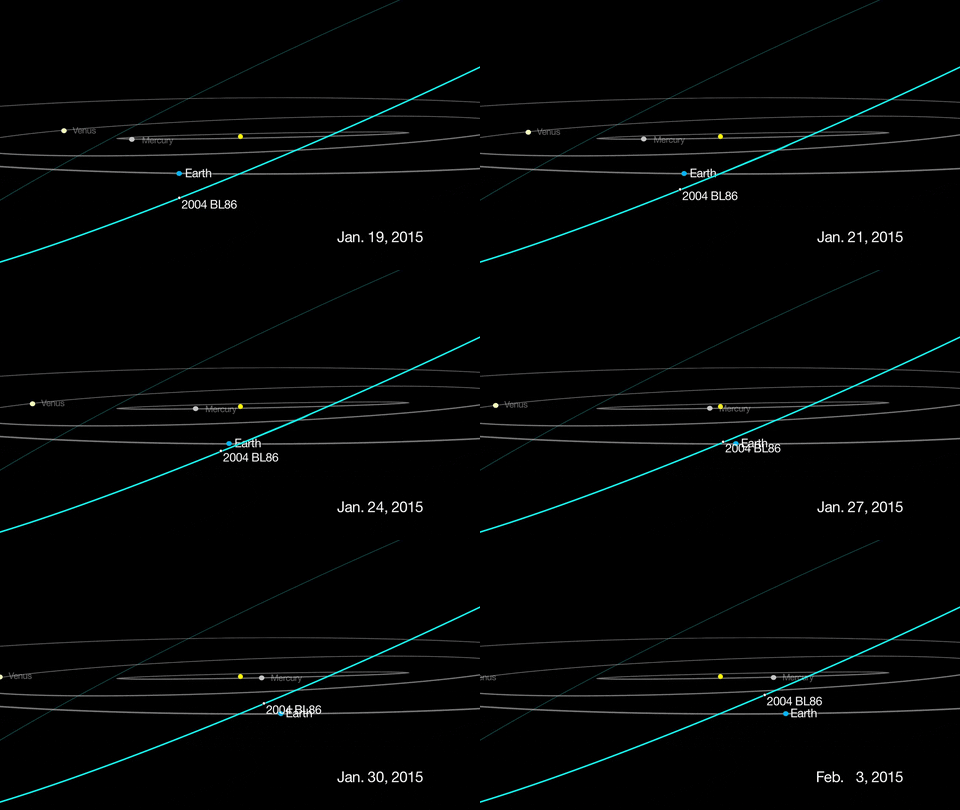
The distance of Asteroid 2004 BL86 is in a safe distance though closer than any other asteroid this big will come until 2027, it's the year when we can expect a visit from another asteroid called 1999 AN 10. The huge asteroid will probably be easiest to find around 11 p.m. ET when it will be to the right of the planet Jupiter and between the constellations Leo and Gemini and it will look like a slow moving star or satellite according to Randy Attwood, executive director of the Royal Astronomical Society of Canada plus NASA will also be watching the asteroid to capture images and data using its Deep Space Network antenna at Goldstone, California and the Arecibo Observatory in Puerto Rico will also be following the close approach. So worry no more but relax and enjoy the night sky because this is something that doesn't happen every single day or maybe not:-)
Thursday, December 4, 2014
Orion Spacecraft Launch - The next generation of space travel into deep space
Subscribe to:
Posts (Atom)